

By Costa Christopoulos, Zhaoyi Shen, and Tapio Schneider Part 12 of our tour of the CliMA software stack. The series began with why we built a new Earth system model; two weeks ago we covered why the Gulf Stream hugs the coast. If all the water vapor in Earth’s atmosphere rained out, it would cover the planet with less than an inch of water, as we saw when we met cloud microphysics. What matters for weather is where and when it rains. An atmospheric river, a band of moist air 400 to 600 km wide and thousands of kilometers long,…
Read More

Blog
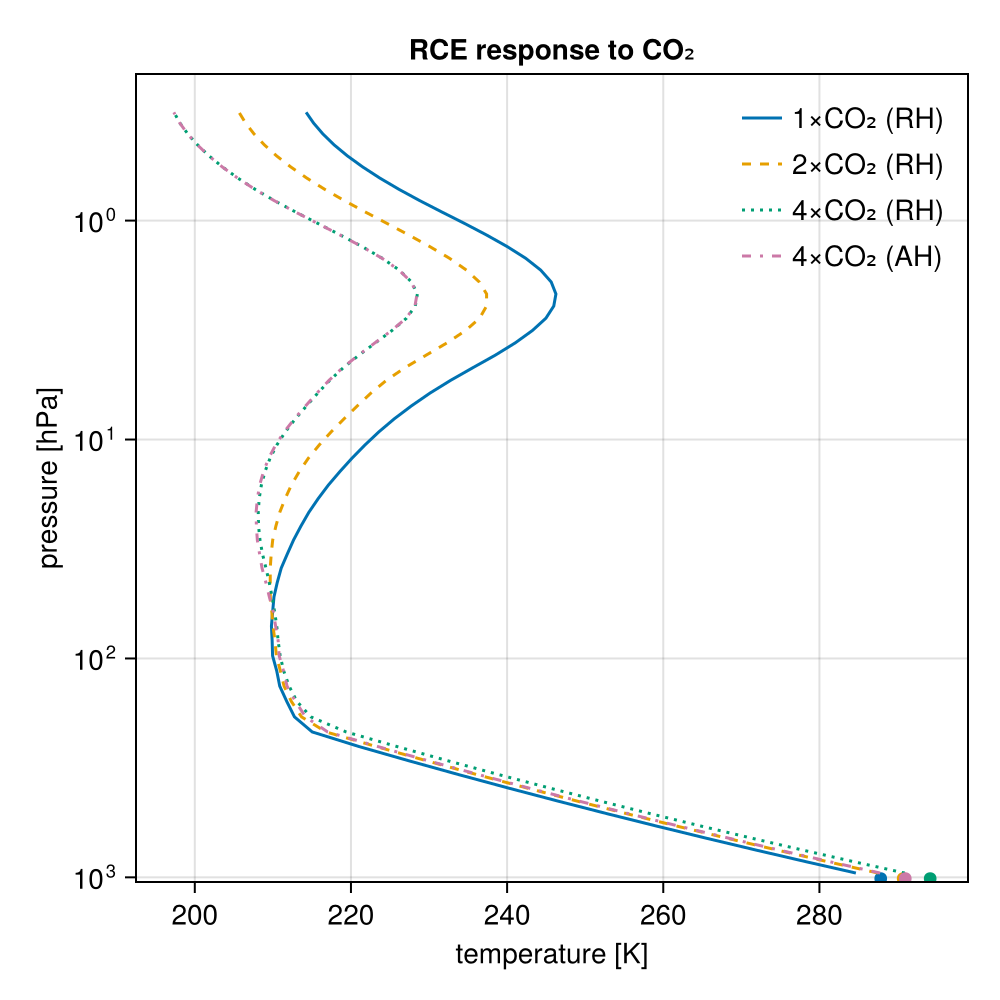
By Zhaoyi Shen and Tapio Schneider. Part 4 of our tour of the CliMA software stack. The series began with why we built a new Earth system model; last week covered methane rain on Titan and the thermodynamics of moist air. Water vapor is the most important greenhouse gas on Earth. Removing all water vapor from an atmospheric column in a one-dimensional climate model cools the surface by 24 K, to well below freezing; removing the CO2 instead cools the surface by 17 K. Yet we do not track water vapor emissions, because water vapor provides a feedback, not a…
Read More
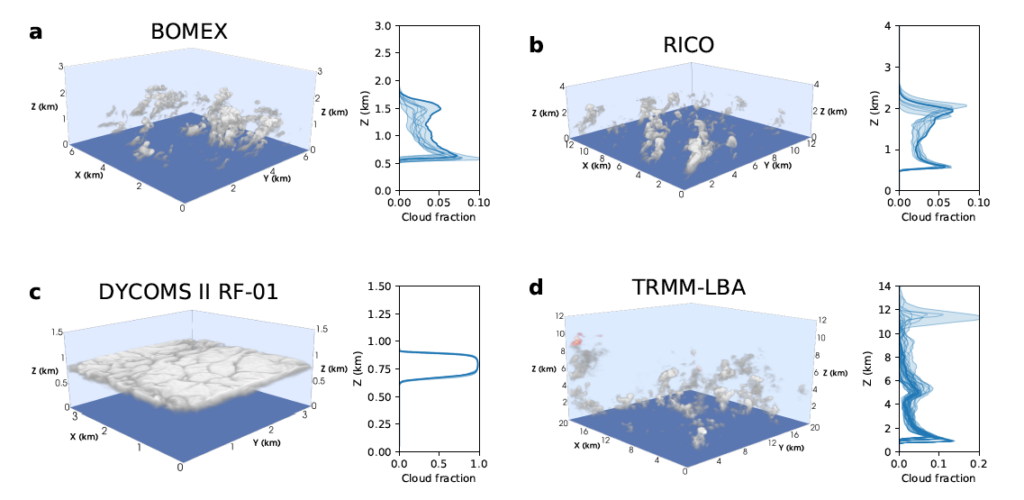
Low clouds play an important role in Earth’s energy budget, but they are poorly represented in global climate models (GCMs). The resolution of GCMs, which is on the order of 100 km in the horizontal, is too coarse to resolve the boundary layer turbulence and convection controlling the clouds. As a result, GCMs rely on parameterizations to represent these processes, and inadequacies in the parameterizations lead to biases in GCM-simulated clouds. To improve parameterizations by calibration with data, we want to harness data from large-eddy simulations (LES). LES directly resolve cloud dynamics and provide high-fidelity simulations in limited areas. However,…
Read More