
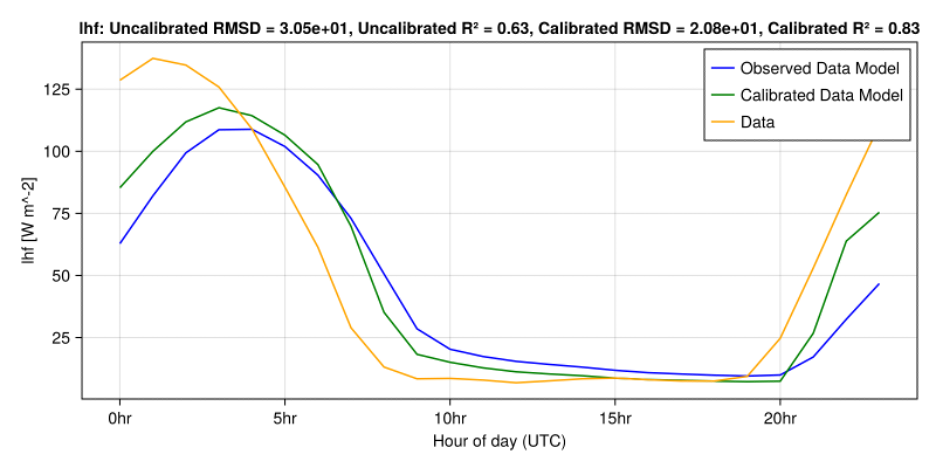
Over a 10-week summer period, the CliMA project welcomed three Summer Undergraduate Research Fellowship (SURF) interns. These undergraduate students were mentored by CliMA project scientists and software engineers on individual research projects that contributed to our model development. Thanhthanh Noel Nguyen, a second-year Caltech undergraduate, collaborated with Software Engineer Julia Sloan and the Land team. Her project focused on calibrating land models using FLUXNET observations, investigating how vegetation parameters vary with environmental conditions. Thanhthanh said “Julia was so patient and understanding to me, always ready to help … Everyone else at CliMA was also super friendly, and I always felt…
Read More

Blog
By Renato Braghiere Vegetation plays a critical role in regulating Earth’s climate by absorbing sunlight, exchanging moisture with the atmosphere, and sequestering carbon. Yet, how vegetation is represented in climate models has remained surprisingly static for decades. Most climate models use a simplified classification called plant functional types (PFTs) — broad categories like “tropical trees” or “grasses” — and assign homogeneous optical properties to each. Real leaves, however, are much more diverse than suggested by PFTs. Their ability to reflect and transmit light varies with chlorophyll content, leaf thickness, and water content — traits that change with seasons, stress, and…
Read More
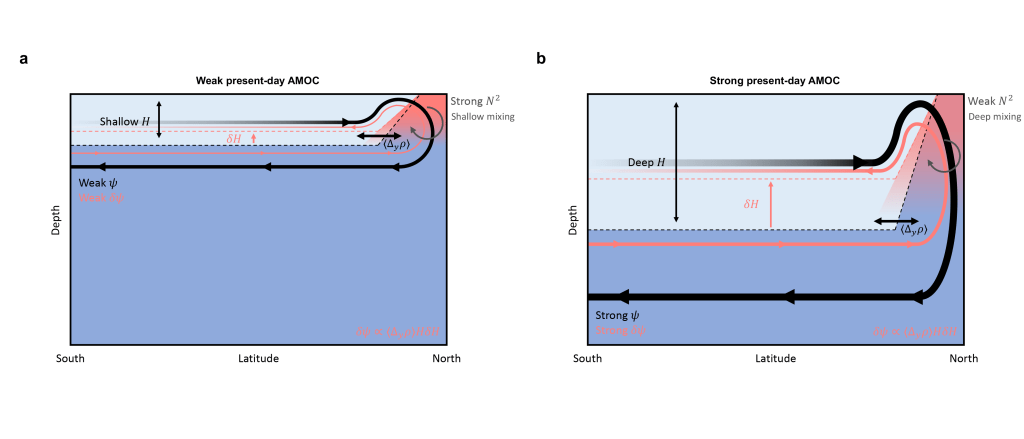
By Dave Bonan The ocean contains a system of currents that connects different ocean basins. A significant feature of this system is found in the Atlantic Ocean basin and often referred to as the Atlantic meridional overturning circulation (AMOC). The AMOC is crucial because it transports warm water northward and helps circulate water between the deep ocean and the surface. As a result, the AMOC plays a vital role in regulating both regional and global climates and can influence weather patterns, such as the African and Indian monsoons, and the summer climate in North America and Western Europe. The AMOC…
Read More

By Emily de Jong The Challenge of Microphysics Scales Clouds provide a crucial link between human action and climate reaction, yet models struggle to represent these harbingers of shade and precipitation and how they respond to warming or human-emitted aerosols. The source of this challenge lies in a separation of scales: the physics that determine how clouds form and precipitate operate at timescales of seconds and length scales of microns. For instance, cloud droplets grow initially through water condensation, and in some clouds they begin to collide with each other, coalescing to form larger and larger droplets that fall out…
Read More

By Julia Sloan. Earth System Models (ESMs) provide valuable insights into the behavior of our planet’s complex interconnected physical systems. CliMA is developing an ESM composed of multiple component models, including atmosphere, ocean, and land. Each of these component models can be run on their own, which is useful for studying each of these domains independently and facilitates testing, calibration, and validation during model development. To gain understanding of the entire global system and predict future climate change, we need to run all of the component models together, including the feedback between them. This is where the coupling component, ClimaCoupler.jl,…
Read More

By Simone Silvestri, Gregory Wagner, and Raffaele Ferrari, for the MIT CliMA group. Ocean eddies—the ocean equivalent of atmospheric cyclones and anticyclones—play a key role in the Earth’s climate system. However, they are not simulated by climate models due to their small scale, between 10 and 100 km, which is below the resolution of standard ocean models. To approximate the climate impact of the missing eddies, modelers employ parameterizations—empirical equations that estimate the collective effect of eddies given resolved model variables such as ocean current strength, temperature, and salinity. Yet, this approach is fraught with uncertainties. For example, a 2002…
Read More
CliMA provides state-of-the-art data assimilation and machine learning tools that enable users to calibrate their models using large amounts of data. CliMA’s research scientists and engineers continually upgrade these tools and made several breakthroughs in the past months. CliMA’s data assimilation and machine learning (DA/ML) team, led by Oliver Dunbar, improved the scalability of one of their machine learning emulators. Think of emulators as accelerated data-driven models, trained to replicate the evolution of a complex system (in our case, a climate model). Once trained, emulators can be run millions of times using few computational resources. These large samples are essential…
Read More
CliMA’s software team, led by Simon Byrne, added a software interface to ClimaCore.jl for saving and loading data from distributed simulations. We caught up with Dr. Byrne near the Gong inside the CliMA conference room; an edited version of our interview is reproduced below. Leilani Rivera-Dotson: Why did your team implement this interface? Dr. Byrne: There are two main reasons we need to be able to save and load data: saving the quantities of interest, such as temperature and precipitation, for analysis and other post-processing tasks; capturing the state of the model so that we can reproduce or resume the…
Read More
Simone Silvestri and Greg Wagner have made substantial progress in improving the numerical accuracy of the ocean component of the CliMA model, Clima-Ocean. Typical finite-volume ocean models for climate prediction use “second-order” schemes to discretize terms in the ocean’s momentum balance. But second-order momentum advection schemes are noisy, and therefore must be paired with artificial viscous terms to suppress spurious oscillations and prevent numerical instability. Artificial viscosity has the unfortunate side effect of artificially suppressing ocean mesoscale turbulence, which plays a fundamental role in Earth’s climate system by transporting heat poleward and determining the ocean’s density stratification. Improving the representation…
Read More

[latexpage] By Ignacio Lopez-Gomez Over the past few years, machine learning has become a fundamental component of some newly developed Earth system parameterizations. These parameterizations offer the potential to improve the representation of biological, chemical, and physical processes by learning better approximations derived from data. Parameters within data-driven representations are learned using some kind of algorithm, in a process referred to as model training or calibration. Gradient-based supervised learning is the dominant training method for such parameterizations, mainly due to the availability of efficient and easy-to-use open source implementations with extensive user bases (e.g., scikit-learn, TensorFlow, PyTorch). However, these learning…
Read More