


By Emily de Jong
The Challenge of Microphysics Scales
Clouds provide a crucial link between human action and climate reaction, yet models struggle to represent these harbingers of shade and precipitation and how they respond to warming or human-emitted aerosols. The source of this challenge lies in a separation of scales: the physics that determine how clouds form and precipitate operate at timescales of seconds and length scales of microns. For instance, cloud droplets grow initially through water condensation, and in some clouds they begin to collide with each other, coalescing to form larger and larger droplets that fall out of the cloud as rain. This process can be described quite accurately at the micron scale of only a few cloud droplets, but it requires drastic simplifications to represent in a 10-km resolution model. Traditional bulk techniques accomplish this by tracking only the total masses of rain, liquid, or ice water in a grid box. These methods classify hydrometeors by their size and require parameterizations to convert particles from one category (ex. cloud) to another (rain), leading to large uncertainties about the combined results of these microphysical processes.
Cloudy.jl: A New Approach to Microphysics
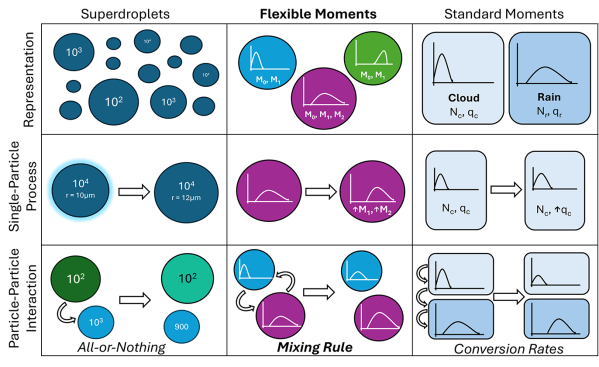
CliMA researchers are rethinking our fundamental approach to microphysics modeling in a new flexible method, “Cloudy.jl” that eliminates the need for these problematic conversion parameterizations. This novel approach combines features of both traditional bulk models and the high-fidelity “superdroplet method” (read more in Sajjad’s post) to track subpopulations of cloud particles through their moments. The modeler can choose to use as few or as many of these subpopulations as they wish in order to balance model accuracy with computational expense. Moreover, Cloudy.jl utilizes generalizable microphysical process descriptions such as the rate of collision between particles based on their size, rather than conversion rates and parameterizations that depend on the model structure or specific hydrometeor categories. The result is a flexible and accurate tool to represent the liquid droplets that make up a cloud.
Idealized Testing with KinematicDriver.jl
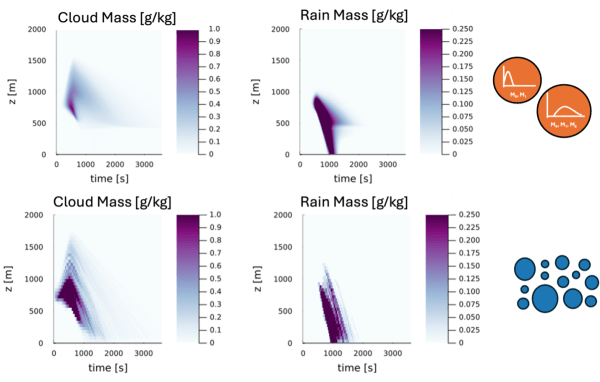
To validate Cloudy.jl and compare it with other microphysics models, we use idealized simulations of a precipitating cloud in KinematicDriver.jl. This package drives the flow field and humidity of a zero-, one-, or two-dimensional domain based on canonical test cases, coupled to a microphysics method of choice. Under these controlled conditions, we can verify that differences in the resulting clouds are due only to differences in the microphysics. Comparing a one-dimensional cloud produced by Cloudy.jl with a high-fidelity superdroplet simulation reveals that this new method can accurately track the trajectory of a cloud from formation through precipitation. Furthermore, we can use this idealized toy model to test different configurations of Cloudy.jl, using more or fewer subpopulations or adjusting the complexity of the microphysical process rates represented.
Looking Ahead
The future of Cloudy.jl is promising, but additional development and testing is required before this new method is fully operational in climate simulations. Ongoing efforts to integrate Cloudy.jl into ClimaAtmos.jl aim to simulate more complex three-dimensional precipitating clouds in a Large Eddy Simulation (LES) configuration. These realistic simulations will allow us to explore the optimal configurations of Cloudy.jl in both high-resolution LES as well as future coarse-grained climate model runs. Ultimately, the aim is to expand Cloudy.jl, which currently handles only liquid-phase hydrometeors, to represent aerosols and ice-phase particles. Doing so will require either innovations to track additional particle properties such as the shape and density of ice crystals, or the integration of Cloudy.jl with existing ice schemes such as the promising P3 method. These developments will enable researchers to represent cloud microphysics in a flexible and unified framework, making it a powerful tool for climate simulations.