

By Renato Braghiere
Vegetation plays a critical role in regulating Earth’s climate by absorbing sunlight, exchanging moisture with the atmosphere, and sequestering carbon. Yet, how vegetation is represented in climate models has remained surprisingly static for decades. Most climate models use a simplified classification called plant functional types (PFTs) — broad categories like “tropical trees” or “grasses” — and assign homogeneous optical properties to each.
Real leaves, however, are much more diverse than suggested by PFTs. Their ability to reflect and transmit light varies with chlorophyll content, leaf thickness, and water content — traits that change with seasons, stress, and species. In our new Nature Communications study, we show that incorporating realistic leaf traits into climate models significantly changes how sunlight is reflected from land surfaces, altering predictions of temperature, precipitation, and carbon uptake.

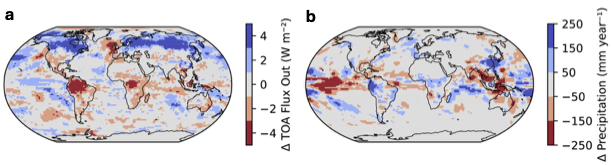
Using a hyperspectral (5-10 nm intervals) version of the CliMA Land model, we derived global maps of leaf optical properties based on observed chlorophyll and leaf mass per area. We then implemented these trait-based values into the Community Earth System Model (CESM), replacing the traditional PFT-based constants. The result? Switching from PFTs to leaf traits made tropical forests darker (lower albedo) and boreal regions brighter (higher albedo). These albedo shifts alter how much solar energy is absorbed at the surface, in some places by more than 5 W.m-², ultimately warming or cooling regions depending on their vegetation type.
These changes in surface reflectance ripple through the climate system. In coupled land-atmosphere simulations, the Amazon warmed, northeast Asia cooled, and global precipitation patterns shifted. For example, in future simulations, the trait-based model projected more than 250 mm/year change in rainfall across parts of the tropics and boreal zones—differences that matter for agriculture and water availability.
Importantly, these modeled changes show better agreement with independent satellite observations and reanalysis datasets, particularly in tropical regions, supporting the realism of the trait-based configuration. This validation strengthens confidence that capturing leaf trait diversity improves the physical accuracy of Earth system simulations.
Our results highlight possible benefits of moving beyond the PFT paradigm in climate models. The fixed optical assumptions baked into many land surface models may no longer be tenable, especially with the growing availability of remote sensing datasets that reveal how leaf traits vary globally and seasonally.
At CliMA, we are working to integrate these high-resolution trait datasets into land surface models that can dynamically respond to environmental conditions. This includes accounting for seasonal leaf changes, water content, and canopy structure — factors that influence how vegetation absorbs light, regulates temperature, and cycles carbon.
Better representations of leaf optics will lead to better simulations of the Earth’s energy budget, water cycle, and carbon balance. This will, in turn, sharpen our ability to forecast regional climate changes and support more informed climate policy and ecosystem management.
Featured images: Global variations in leaf reflectance and transmittance based on leaf chlorophyll content and leaf mass per area. From Wang & Braghiere et al., 2025.