

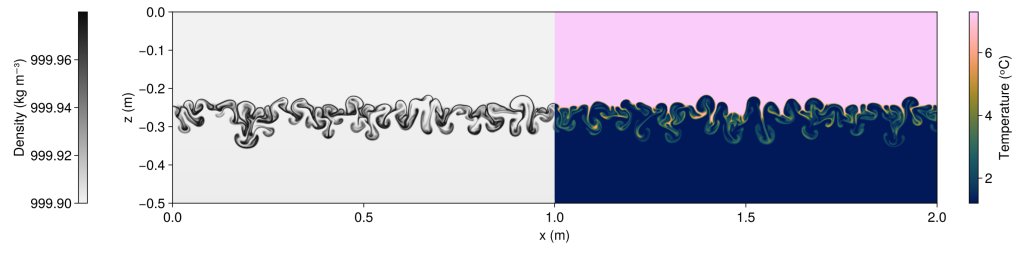
Numerical modeling is one of the pillars of ocean and climate science, and numerical simulations of ocean processes are critical for climate projections. Fortunately, recent rapid progress in computational tools — driven by AI — holds massive potential for accelerating numerical model development, and therefore progress in ocean and climate science. But this potential isn’t yet realized because traditional models can’t use AI hardware, don’t benefit from new programming tools and languages designed to accelerate AI model development, and can’t solve the full breadth of emerging ocean modeling problems. Enter Oceananigans — a popular, next-generation, GPU-accelerated ocean modeling framework developed by the Climate Modeling Alliance in Julia that redefines what’s possible in ocean simulation. Eos magazine highlighted the implications: “A Leap Toward Next-Generation Ocean Models“.
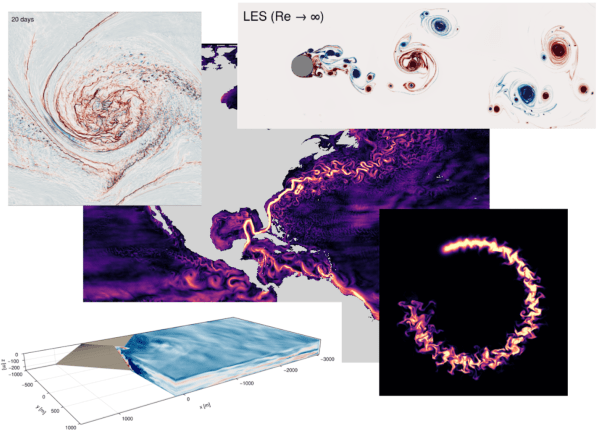
The Oceananigans vision — described in a new preprint recently released by the Climate Modeling Alliance (Wagner et al 2025a) — combines a powerful user interface with simple, yet accurate numerical methods optimized for high-resolution simulations on GPUs. Implementing this vision has produced a modeling system that is accessible, accurate, and rapidly-developed. The potential of our vision is evidenced by our progress: capabilities to simulate any scale of oceanic motion with a range of techniques, the development of numerical methods (Silvestri et al 2024), automatically calibrated parameterizations (Wagner et al 2025b), and unprecedented performance (Silvestri et al 2025). We are also embedding neural networks and other ML tools to represent subgrid-scale physics in Oceananigans simulations (Lee et al., in preparation) as in other Earth system model components. The revolution has only just begun.
Featured image from https://glwagner.github.io/assets/pdf/Oceananigans.pdf
References
- Wagner, G. L. et al. (2025a). High‑level, high‑resolution ocean modeling at all scales with Oceananigans. Journal of Advances in Modeling Earth Systems, (In review; preprint at arXiv:2502.14148).
- Wagner, G. L. et al. (2025b) “Formulation and calibration of CATKE, a one-equation parameterization for microscale ocean mixing.” Journal of Advances in Modeling Earth Systems, 17, e2024MS004522.
- Silvestri, S. et al. (2024). “A new WENO-based momentum advection scheme for simulations of ocean mesoscale turbulence” Journal of Advances in Modeling Earth Systems, 16, e2023MS004130.
- Silvestri, S. et al. (2025). “A GPU‑based ocean dynamical core for routine mesoscale‑resolving climate simulations.” Journal of Advances in Modeling Earth Systems, 17, e2024MS004465.
- Ramadhan, A. et al. (2020). “Oceananigans.jl: Fast and friendly geophysical fluid dynamics on GPUs.” Journal of Open Source Software, 5(53).